The Brinker family’s poverty
Hans Brinker, or The Silver SkatesThe Brinker family’s poverty shapes the household’s work, care, and choices, but its sharpest crisis comes just as Raff Brinker returns to himself. His recovery brings joy and the hope of a restored family life; it also reveals needs the family cannot meet. With almost no food, dwindling fuel, and no money in the house, Hans Brinker must find a way to provide for his father without surrendering the family’s sense of self-reliance.
Household Economy and Labor
Dame Brinker supports the family through several kinds of work: she raises vegetables, spins, and knits. In the past, she also worked aboard canal barges and sometimes joined other women in towing a vessel between Broek and Amsterdam. As Hans grew strong enough to take on the hardest work, he insisted on doing that labor in her place. Her responsibilities did not end there: Raff had become so helpless that she had to care for him constantly, although his strength could make him difficult to manage.
The children also contribute substantially to the household economy. Hans and Gretel Brinker perform almost all the work outside the home as well as much of the domestic labor. In some seasons they gather peat, stacking it in square pieces for fuel. When his schoolwork allows, Hans rides the towing horses on the canals for a few stivers a day; Gretel tends the geese of neighboring farmers. The family’s survival thus depends not on a single wage but on a patchwork of seasonal work, small earnings, and the children’s time.
That work takes place in a landscape where movement and livelihood depend on managed waterways. Canals carry barges and towing horses, while dikes and sluices guard low-lying land from water. The surrounding country also requires sustained communal labor: windmills pump water and help protect the lowlands, and dikes must be repaired to keep settlements habitable. These details establish a world organized around work and maintenance, though the family’s immediate hardship is more intimate: the food, fuel, and labor available at home are barely enough for daily needs.
Care and the Household’s Limits
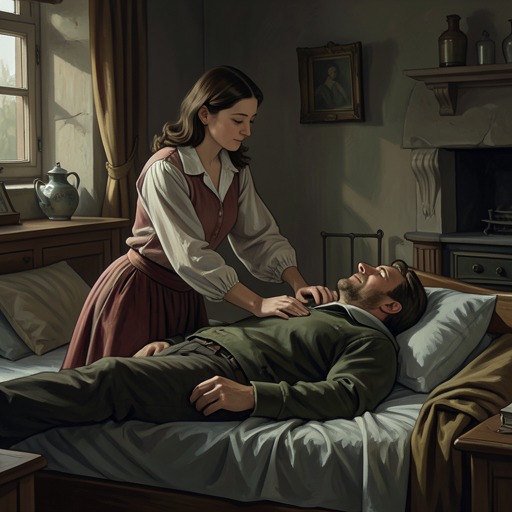
Poverty is compounded by the time and attention required to care for Raff. Dame Brinker must attend to him while keeping the household going; Hans and Gretel share both practical work and domestic responsibilities. When Raff lies ill, Gretel cleans the rough brick floor, brings peat to build up the fire, and melts ice for her mother’s use. She then urges Dame Brinker to rest, arranging the willow bed and setting aside her mother’s jacket and dress. Care is not separate from the family’s economic struggle: it occupies the same hours and resources needed for earning, cooking, and keeping the home warm.
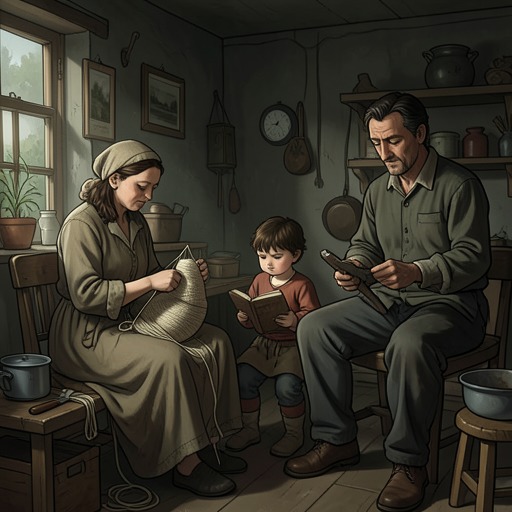
The scene at the cottage the day after the doctor’s visit initially appears calm and comfortable. Dame Brinker sits knitting, Raff sleeps quietly, and Gretel kneads rye bread. Yet this settled picture does not mean the family has secure means. When Hans arrives, Dame Brinker tells him that Raff is starving and that the doctor has said he must be fed. The news makes the gap between recovery and recovery’s practical demands impossible to ignore.
Recovery and Acute Want
The doctor’s instructions require food the family does not have. Dame Brinker fears that their usual black bread and porridge will be too heavy for Raff and understands that he needs meat, sweet wine, and a warm covering. There is not a stiver in the house. Gretel’s tears fall into the dough as she listens. Her mother also explains that the family’s peat is nearly exhausted: Raff has used much of it by throwing it on the fire when she was not watching.
The household’s shortages are more severe than Hans had understood. The peat is almost gone, and all the flour is already in the dough Gretel is preparing. During the preceding days, the family had scarcely eaten, but their attention had been absorbed by Raff’s recovery. Dame Brinker had expected that she and the children would earn money before the situation became desperate, and she had not told Hans that the few silver pieces kept in an old mitten were gone. The return of hope had not relieved the family’s poverty; for a time, it had distracted them from how little remained.
Hans’s Response and the Meaning of Poverty
Hans answers the immediate need with a promise that he will bring meat and wine before night. He offers his bed covering for Raff and says that he can sleep in the straw. When Dame Brinker points out that the food they have is unsuitable and that the fuel is running out, Hans proposes cutting down the willow tree and insists that he will find work. He reassures her that the worst is past because Raff is himself again, trying to turn their renewed family hope into confidence that the practical crisis can also be overcome.
That confidence does not erase the difficulty of finding help. After an unsuccessful errand, Hans considers approaching Peter van Holp, who had offered to help if he could. He also thinks of going to Amsterdam to earn money for the following day’s supplies. But asking for assistance feels to him like begging, something no Brinker has done. He worries that Raff, newly returned to awareness, would learn that his family had asked for charity. Hans therefore considers borrowing against a watch instead, believing he can find work and recover it later. His choice shows poverty as more than an empty purse: it narrows the available options and makes the distinction between aid and shame a burden he must negotiate while his father needs food immediately.
The family’s condition is presented through repeated acts of labor and care rather than as an abstract label. Dame Brinker earns, tends Raff, and keeps the household moving; Hans and Gretel work alongside her, and the children take on duties that leave little space for rest. Raff’s recovery changes the family’s emotional circumstances, but it does not instantly restore food, fuel, or income. The crisis makes the cost of that gap visible: love and renewed hope can sustain the family, but they cannot supply the necessities Hans must urgently seek.